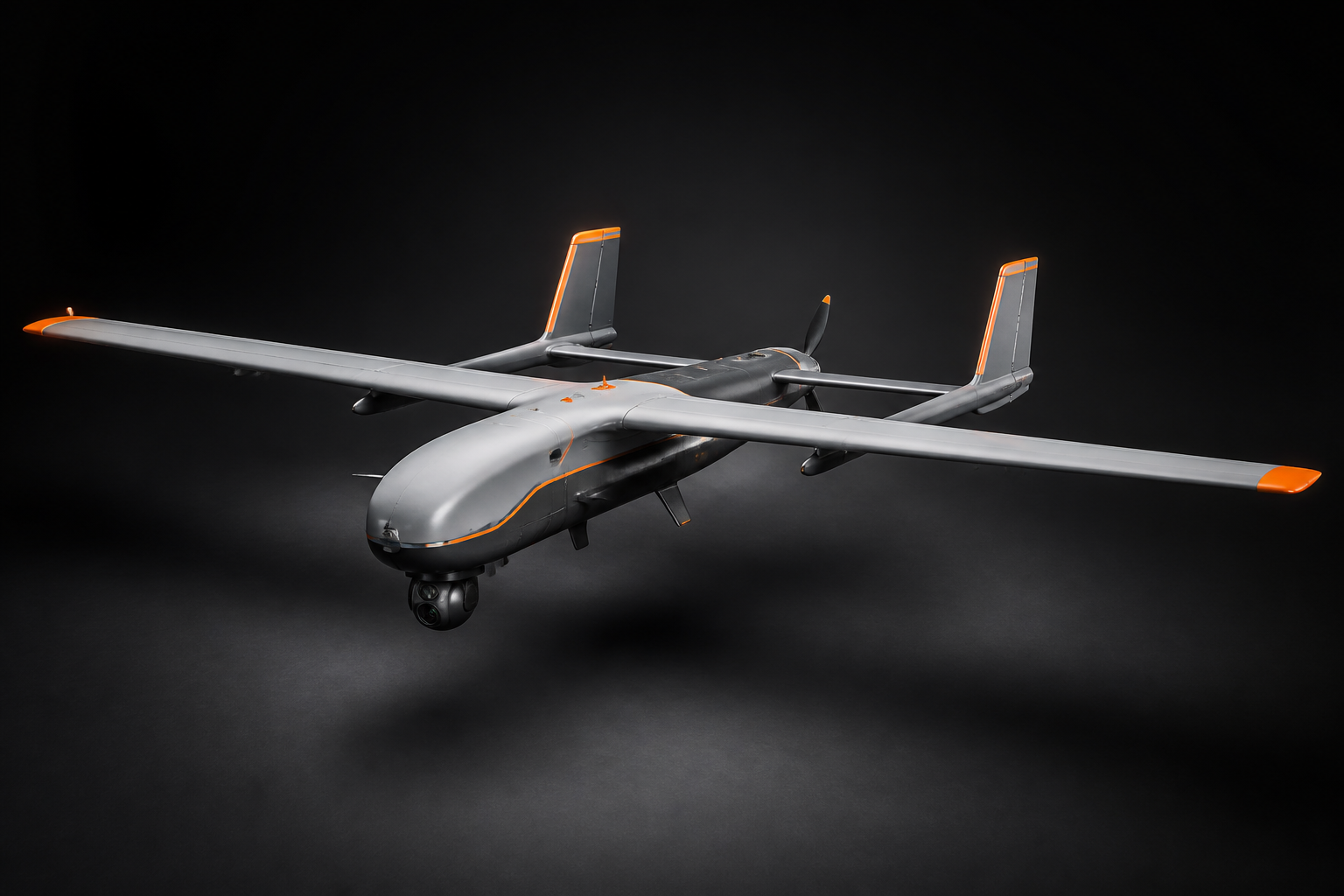
The VTOL fixed-wing answers the oldest complaint about fixed-wing drones — where do I land it? — by bolting a lift system onto a cruising airframe. The result takes off like a multirotor and flies like an airplane.
- Four lift rotors handle take-off and landing; a separate cruise propeller and the wing handle forward flight
- The transition happens at safe altitude: the wing takes over lift as airspeed builds, then lift rotors stop and feather
- The lift system costs roughly 10–15% in cruise efficiency versus a pure fixed-wing — the price of runway freedom
- For mapping and inspection teams, eliminating launch sites and catapults outweighs that penalty almost everywhere
The flight sequence
Take-off is pure multirotor: the four lift motors raise the aircraft vertically to transition altitude, typically 20–40 m. The cruise motor then accelerates the aircraft forward while the wing picks up the load; once airspeed passes the transition threshold, the lift motors shut down and their propellers align with the airflow to minimize drag. Landing reverses the sequence — the aircraft decelerates, lift motors respin, and it descends vertically onto a spot the size of a parking space.
What the hybrid layout costs
The lift system is dead weight in cruise: motors, propellers and booms that add drag and mass. Designers claw back some of the loss with feathering propellers and clean boom fairings, but a pure fixed-wing of the same class will always cruise somewhat more efficiently. A platform like the SkyRanger V400 still achieves 8 hours of endurance because the airframe is optimized around exactly this trade.
Why it won the mapping market
Catapults need trucks and setup time; belly landings risk sensors; runways rarely exist near the survey block. VTOL removes all three constraints at once — crews launch from forest clearings, rooftops and boat decks, and the sensitive camera never touches the ground. For most commercial teams that flexibility is worth far more than ten percent of cruise efficiency. How that compares with other layouts is covered in Fixed-Wing or Multirotor? An Industrial Drone Selection Guide.
FAQ
What happens if a lift motor fails in cruise?
Nothing immediately — the lift system is unused in cruise. The autopilot will divert to a runway-style belly landing or parachute if the failure is detected before the landing transition.
Is hover time limited?
Yes. Hovering burns 5–10× cruise power, so VTOL segments are kept to a couple of minutes. This is a transit mode, not a working hover — that remains multirotor territory.

