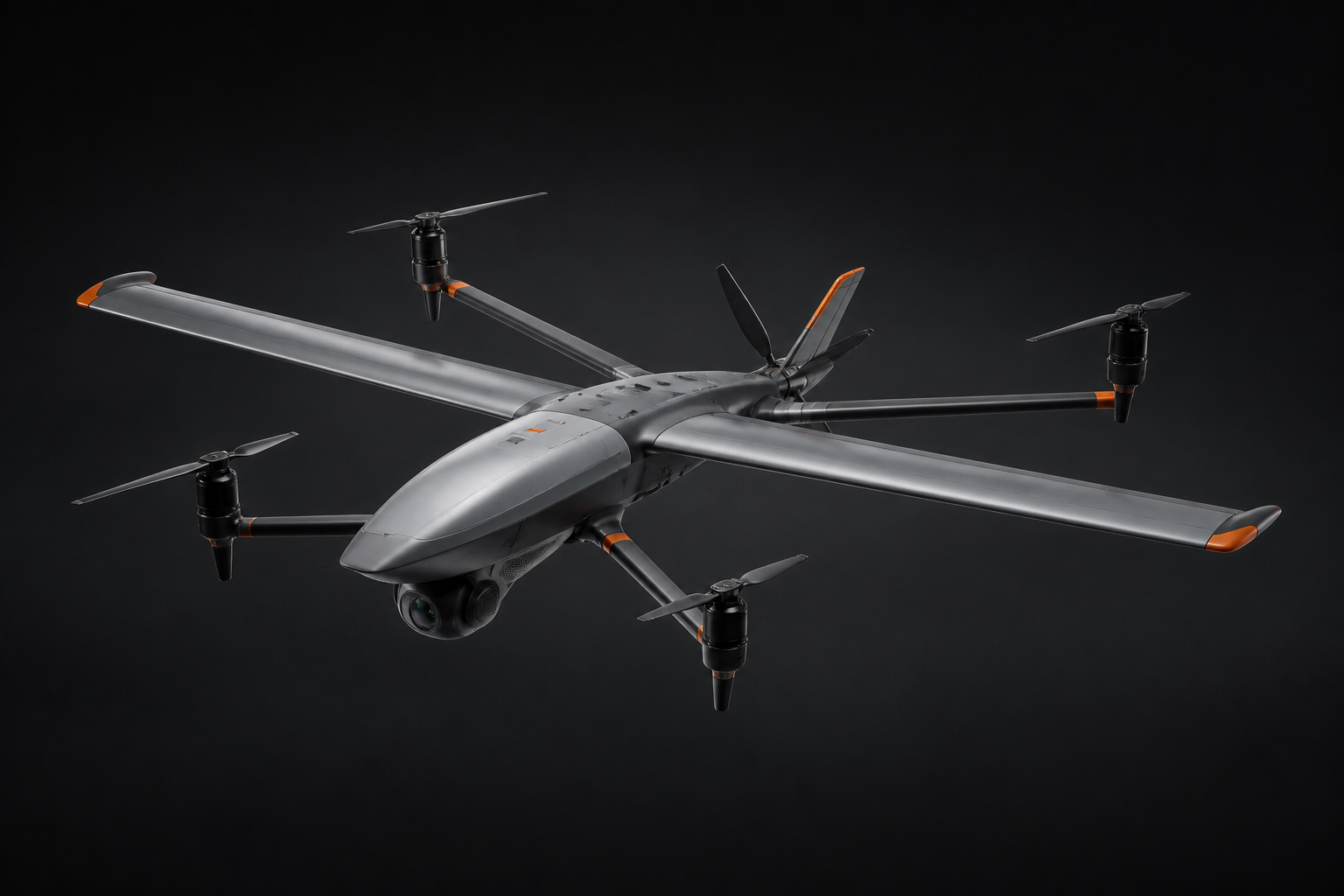
The one-sentence answer: choose a fixed-wing for large areas and long missions; choose a multirotor when you need to hover, take off vertically, or lift heavy loads. Picking the wrong platform type is the most expensive mistake in industrial drone procurement — using a multirotor for wide-area mapping costs you 5–10× in efficiency.
- A fixed-wing in cruise burns roughly 1/3–1/5 the energy of a hovering multirotor; endurance is typically 4–10 hours versus 30–60 minutes
- Above roughly 50 km² of coverage per day, the fixed-wing advantage is irreplaceable
- For 20 kg+ payloads, point operations or frequent take-offs, a heavy-lift multirotor is the only real answer
- VTOL fixed-wings combine both strengths and are now the mainstream choice for mapping and inspection
The fundamental difference
A fixed-wing generates lift with its wing — it must move forward to fly, which makes it fast, efficient and long-legged, but it cannot hover. A multirotor pushes air straight down with its propellers — it can hover and land anywhere, but it fights gravity at full power every second, so endurance is short. That physics decides the division of labor; no marketing changes it.
Match the platform to the mission
| Mission type | Recommended platform | Key metrics | Reference model |
|---|---|---|---|
| Wide-area aerial mapping | VTOL fixed-wing | Endurance, PPK accuracy | SkyRanger V400 |
| Long-distance line patrol | Long-range fixed-wing | Range, dual-sensor payload | SkyRanger V800 |
| Ultra-long-range geophysical survey | Canard fixed-wing | 1,000 km-class range | SkyRanger C900 |
| Spraying / sling loads / rescue | Heavy-lift multirotor | Payload, RTK hover | SkyLifter H40 |
The three most common traps
First, buying an industrial aircraft with a consumer mindset — camera megapixels and obstacle avoidance are not operational capability; endurance, payload interfaces and datalink range are. Second, ignoring ground-crew cost — a spraying multirotor swaps batteries dozens of times a day, and without a charging plan the best aircraft sits idle. Third, comparing unit price instead of cost per square kilometer — a fixed-wing may cost twice as much yet cover five times the area per day, making it cheaper where it counts. For a deeper method, see How to Choose a Mapping Drone: Balancing Endurance, Accuracy and Payload.
FAQ
Can I fly a fixed-wing without a runway?
Yes. A VTOL fixed-wing uses lift motors for take-off and landing, then transitions to wing-borne cruise. Rooftops, decks and mountain sites all work — see How VTOL Fixed-Wings Take Off Without a Runway.
Can one system cover both mapping and spraying?
Not recommended. The platforms, payloads and workflows are entirely different; forcing one system to do both means doing both badly. On a limited budget, buy for your core business first.
Which is easier to learn?
Multirotors are intuitive with a low barrier to entry. Fixed-wings rely on route planning and the autopilot, demanding more of the operator — but with modern fully autonomous platforms the gap has shrunk to about a week of training.

