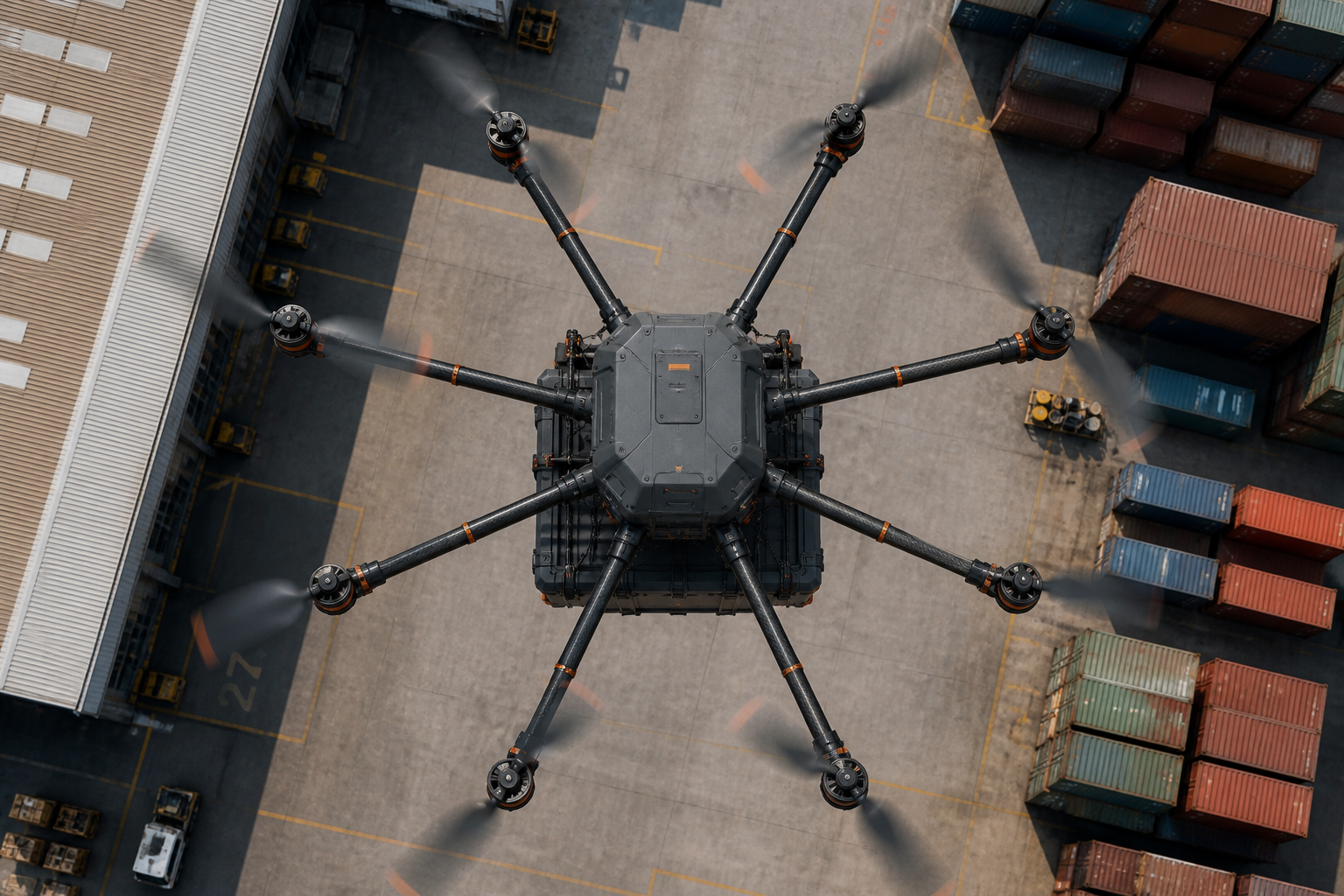
Drone delivery works today wherever the straight line beats the road by enough to pay for the aircraft. Four scenarios already clear that bar — none of them involve delivering coffee downtown.
- Island resupply: minutes across water that ferries cross in hours, on fixed schedules
- Mountain sites: construction and telecom resupply where every road trip is an hour of switchbacks
- Medical transport: samples and blood products moved on time-critical, low-mass runs
- Ship-to-shore: documents, parts and provisions without a launch boat
1. Island and cross-water resupply
Water is the perfect drone corridor: no obstacles, no people, straight lines. A heavy-lift multirotor like the SkyLifter H40 moving 40 kg per rotation replaces a boat schedule for daily essentials, while the boat handles bulk. Reliability in coastal wind is the platform requirement to check.
2. Mountain-site logistics
Telecom towers, construction camps and monitoring stations in terrain where a pickup spends two hours on switchbacks are natural drone customers. Sling loads or cargo boxes deliver tools, food and parts on demand; the winch mount drops loads without landing on slopes.
3. Medical and cold-chain runs
Lab samples, blood products and vaccines are low-mass, high-urgency cargo — the ideal drone payload. Insulated boxes with data loggers satisfy the cold-chain paperwork, and fixed routes between clinic and hospital make approvals repeatable.
4. Ship-to-shore transfer
Anchored ships routinely need documents, small parts and fresh provisions. A drone eliminates the launch-boat round trip; deck landings need practice and a spotter, but ports running this daily report the fastest payback of any scenario here.
The common denominator
All four share fixed routes, repeat customers and a clear cost baseline to beat. If your route changes daily and your recipient is a stranger, the economics collapse. Start with one route, fly it on schedule for a month, and expand from proof.
FAQ
What payload class do I need?
Most working routes carry 10–40 kg. Below that, the trip rarely beats a motorbike; above it, you are in crewed-aviation territory for now.

